
What Is Single-Cell ATAC-Seq?
Single-cell Assay for Transposase-Accessible Chromatin (Epi ATAC) sequencing is used to characterize chromatin states in individual cells. This is different from bulk ATAC sequencing, which provides an average readout of chromatin states in all cells in a sample.
For heterogeneous samples and sub-populations, single-cell is a more accurate, informative choice.

Why Is ATAC-Seq Important?
ATAC sequencing is useful for identifying open chromatin regions. These regions are typically associated with active transcription factors impacting phenotype or disease states.
Single-cell ATAC-seq provides another level of specificity and differentiation. In tumor, tissue, and other heterogeneous samples, single-cell ATAC sequencing can map the epigenetic profiles of unique cell groups.

About the Technology
10x Genomics Chromium X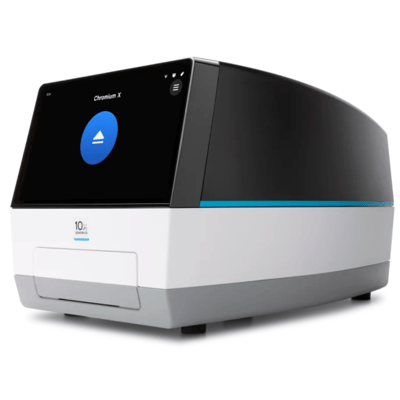
The Chromium X instrument simplifies, automates, and scales single-cell sequencing projects with proprietary cell partitioning and reagent delivery technologies. Downstream analysis is simplified with unique barcodes for each cell partition.
Multiome GEM-Based Sequencing
10x Genomics’ GEM-based sequencing makes it possible to study complex biological samples at single-cell resolution. This technology keeps each cell’s genetic material uniquely labeled from the start of the project.
Nuclei are combined with barcoded gel beads and partitioned into tiny oil droplets called Gel Beads-in-Emulsion (GEMs), where lysis and molecular tagging happen in parallel. Inside each GEM, nucleic acids are tagged with a unique barcode, so all sequencing reads can later be traced back to their original cell.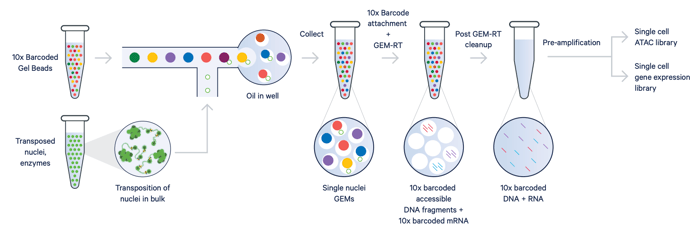
After the droplets are broken , two libraries are prepared (ATAC, 3`GEX), and next-generation sequencing is performed. The barcodes enable researchers to reconstruct a high-resolution view of gene expression, chromatin accessibility, or immune profiles, cell by cell.
About the Workflow

DNA Fragmentation
Transposase enzyme is added to suspension; single nuclei in suspension are first transposed.

Partitioning
A GEM encapsulates each reaction within the Chromium system.

Barcoding
Transposed DNA fragments are distinguished with one of approximately 750,000 barcodes.

Library ConstructionThe resulting library is used for scATAC-seq. In Epi multiome ATAC, two libraries are generated for scATAC-seq and 3` gene expression.