
What Is Shotgun Metagenomic Sequencing?
Metagenome shotgun sequencing (MGS) involves sequencing all DNA from a microbial community, including bacteria, archaea, fungi, and viruses.
Unlike 16S Amplicon Sequencing, MGS provides a comprehensive, unbiased view of the community's composition and functional potential (e.g., metabolic pathways) and allows for the identification of critical genes, such as Antibiotic Resistance Genes (ARGs), at strain-level resolution.

Why Is Shotgun Metagenomic Sequencing Important?
The ability to assess the entire genomic content of a sample and identify the metabolic pathways and associated functions of a community make this approach a standard to describe samples from diverse sources.
Psomagen's MGS service combines deep sequencing data with advanced bioinformatics to answer not just "who is there?" but precisely "what they are doing?"

What Can You Do?

Clinical Microbiology
Identify unknown microorganisms and pathogens in outbreaks or human diseases

Microbial Ecology
Discover new microorganisms and genes by mapping a functional profile of microbial communities and their internal and environmental interactions

Drug Development
Identify novel genes, biological compounds, antibiotics, and enzymes with clinical and industry applications

Disease Factors
Categorize associations between the human microbiome and disease states
New FAST-Meta Options
We're offering new solutions for high-quality shotgun metagenomic sequencing samples. Save with a streamlined workflow, delivering FASTQ files and data quality reporting in 5 business days, compared to 4-5 weeks for a standard workflow.
Visit the product page to see if FAST-Meta might work for your next project:

Bioinformatics analysis options
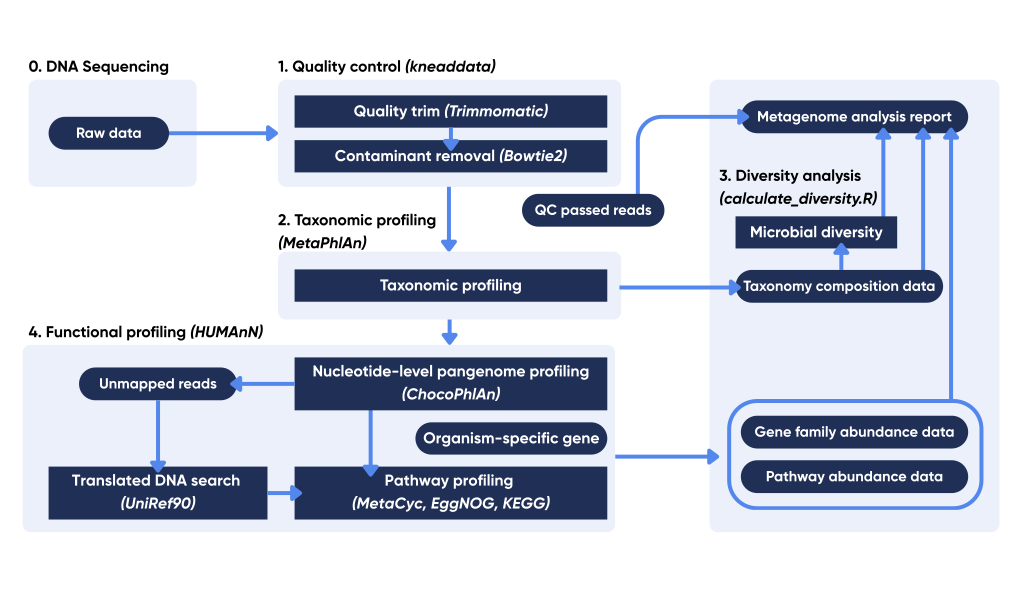
1. Core Analysis Pipelines: Mapping vs. Assembly
We offer two powerful analysis pipelines. The choice depends on your research goal: accurate profiling of known functions (mapping) or discovery of novel genomes (assembly).
Mapping-Based Analysis (Recommended Standard)
This is our standard, rapid, highly accurate pipeline for profiling microbial communities. Reads are mapped directly against curated, industry-leading reference databases.
-
Host DNA Depletion: The first critical step is removing host DNA to focus analysis on the microbial data.
-
Taxonomy Profiling (MetaPhlAn4): Uses species-specific marker genes for highly accurate taxonomic classification and abundance.
-
Functional Profiling (HUMAnN3): Identifies the abundance of gene families, pathways (MetaCyc, KEGG, Kofam, EggNOG).
Assembly-Based Analysis (MAGs & Novel Discovery)
For researchers focused on novel gene discovery or reconstructing genomes from unknown species.
-
Process: Reads are assembled into longer contigs, which are then "binned" to create Metagenome-Assembled Genomes (MAGs).
-
Functional Annotation (DRAM): MAGs are annotated to analyze the metabolic functions of complex, uncultured microbial genomes.
-
Recommendations: Assembly from short-read data is computationally intensive. For projects focused on generating high-quality MAGs, we recommend our metagenome long-read sequencing service for superior results.
2. Standard Report Deliverables
Our standard service includes raw data and basic analysis (QC & taxonomy) as the default delivery. If you require only raw data (FASTQ files) without basic analysis, please inquire about a price discount.
|
Result Type |
File Format |
Basic Report |
Advanced Report |
Core Deliverables |
|
Raw Data |
FASTQ |
Default |
Default |
Raw sequencing data. |
|
QC & Taxonomy |
HTML, XLSX, PNG |
+ |
+ |
QC stats, taxonomy abundance matrix, diversity analysis. |
|
Functional Analysis |
HTML, XLSX, PNG |
- |
+ |
Gene family abundance (heatmap), pathway abundance (heatmap). |
|
Statistical Analysis |
HTML, PNG |
- |
Optional |
LEfSe, PCoA biplot, Venn diagram, advanced heatmaps. |
Advanced Analysis Options (Custom Add-ons)
-
Comparative Genomics: Genome-level comparison and phylogenomic analysis across samples.
-
Statistical Modeling: Multivariate statistics, correlation analysis, and machine learning for biomarker discovery.
Our Analysis Pipeline
On-Going Promotions
We're always adding new deals — check in often for updated promotions!

Why Our Clients Choose Psomagen

Superior Data Quality
Exceeds manufacturer benchmarks

Fast Turnaround
Starting at one week for sequencing projects

US-Based Processing
Sequencing and customer support in Rockville, MD

Ph.D. Level Support
Expert assistance every step of the way, with real-time project updates through our online system

Automated Workflows
Increase scalability and improve reproducibility

CLIA-Certified, CAP-Accredited Labs
Clinical research options available (inquire for more information)

Complete Sequencing Solutions
From extraction to data analysis, with many sample types accepted