
Omics Services // Single-Cell Sequencing
Cellanome R3200
Collect both morphological and single-cell sequencing data from the same cells. AI-assisted cell isolation and proprietary Cell Cage Enclosure technology make Cellanome the perfect partner for high-complexity projects.

About CellCageTM Enclosure Technology.svg)
Cellanome's proprietary micro-3D-printed CellCageTM Enclosures (CCEs) use AI-assisted workflows to capture individual cells or ensembles for in-depth exploration.
Adjustable CCE size and shape allow for a truly tailored experimental environment. Learn more about CCEs, workflows, and imaging on the R3200 in our latest video walkthrough.
How It Works
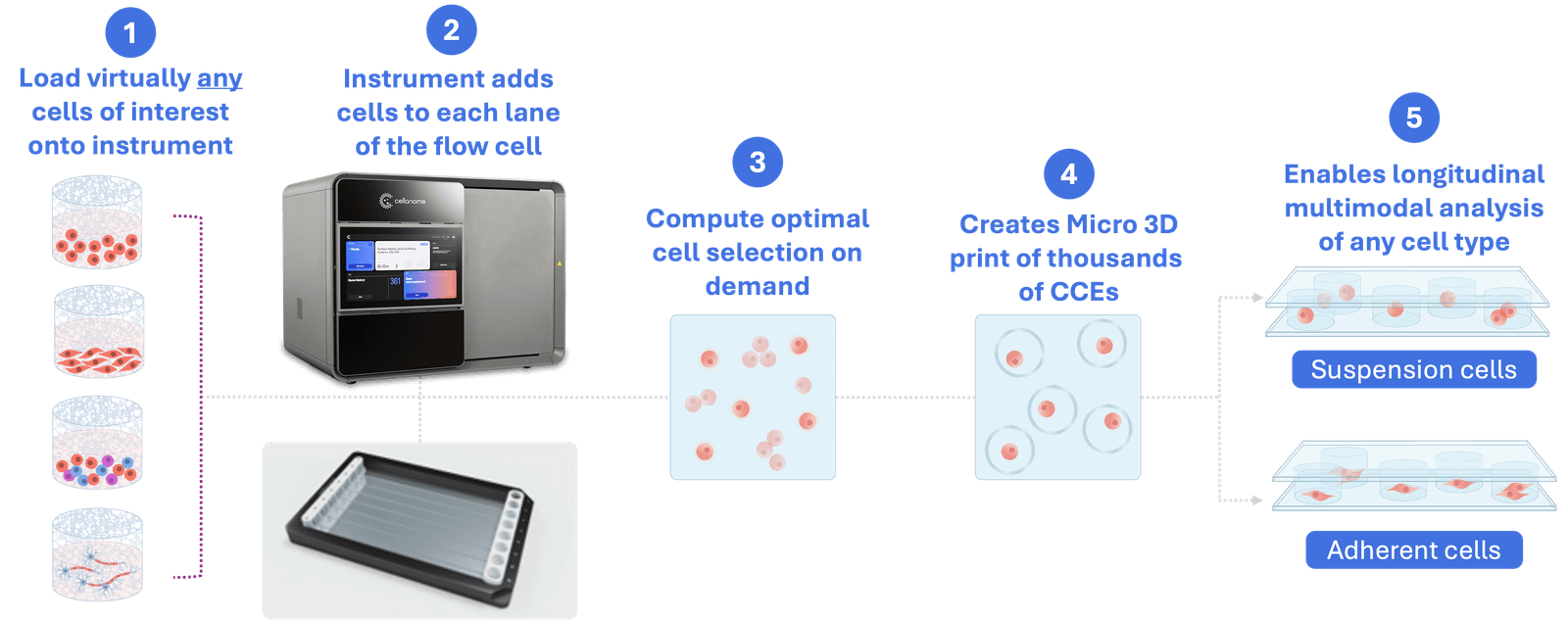
What's In a Sample?
See Differently with Cellanome

Suspensions
Isolate and profile free-floating cells with high viability and minimal bias, ensuring accurate representation of heterogeneous populations.

Adherents
Capture intact cells in their native, surface-adhered state, preserving morphology while minimizing transcriptomic alterations from cell removal.

Co-Cultures
Dissect complex cell–cell interactions by isolating distinct populations from mixed systems. Enable precise analysis of each cell type within its functional environment.
What Can You Do?

Immuno-oncology
Investigate mechanisms of disease modulation. Track direct tumor-immune interactions and morphology changes over days.

Neurobiology
Link functional outputs to the transcriptomes of each individual cell. Co-culturing neurons, astrocytes, and microglia enables studying cell-cell and network interactions. Study neural differentiation, neurite outgrowth, and glial responses over time.

Drug Research & Discovery
Simulate treatment regimens to detect how drugs impact cell states, pathways, and responses, including heterogeneous responses. Assess safety concerns and efficacy of combination therapies.
Understanding the Technology
Ready to dive deeper? Our Cellanome guide explains:
-
Historic barriers to single-cell discoveries.
-
How cellanome makes paired imaging and single-cell transcriptomics possible.
-
Data collection capabilities.
-
Examples of the Cellanome in use for real-world research.