
As a CRO specializing in single cell sequencing, we often get asked which approach our customers should take and what differences there are in the resulting data output. There are many variables that impact this choice, including sample type and the biological question, which we will attempt to cover in this article. Tissue processing methods can limit the options to single nuclei instead of single cells. In some cases, the cell type is too large for a microfluidic device thus an alternative approach is required. Our goal is to delve into the details and nuances of these factors and provide a resource that our customers can use to plan their single cell experiments. Psomagen is a Certified Service Provider (CSP) for 10x Genomics and also offers Parse Biosciences’ single cell technologies thus the content will focus on those platforms.
The basics: what's different about the input?
Sample type is a strong contributor to the type of sequencing you can perform. Here are several common sample types:
- Fresh cells (PBMCs, cell culture, dissociated tissue, etc.)
- Cryosuspension of cells (PBMCs, cell culture)
- Cryosuspension of cells from dissociated tissue
- Fresh tissue
- Frozen tissue
- Fixed frozen tissue
- FFPE tissue
- Blood (Apex)
If you haven’t started collecting your samples, now is the time to consider how that collection method will impact your downstream experimental options. For example, if you know you need whole cellular RNA, not just nuclear RNA, then it’s important to dissociate fresh tissue at the time of collection; it can be processed promptly for scSeq or frozen, fixed frozen, as a cryosuspension for later analysis. Note that dissociation can lead to transcriptional activation thus it’s important to consider this when comparing samples processed in different ways and to published data that may have utilized different preparation methods.
Fresh cells or cryosuspensions are suitable for single cell sequencing, assuming the viability requirements can be met. It’s critical that the samples have >70% viability for scSeq applications and methods to enrich a viable population like the Levitas EoS have shown great efficacy in improving scSeq results.
If you need cell surface proteins or TCR/BCR receptor sequences, it is essential that you prepare your samples for scSeq, not snSeq. That means dissociating the fresh tissues to cryosuspensions or cryopreserving the cells as a suspension.
If the tissue is merely snap frozen, the options for successful downstream processing become limited. The option to dissociate the tissue into a cell suspension effectively disappears if you freeze the tissue. Although there are protocols that promote that approach and tout success, it’s not broadly effective with the majority of tissues/cell types. Snap freezing, fixed freezing or FFPE preparation of tissue will typically limit you to single nuclei sequencing (snSeq).
If it’s a longitudinal study and you need to fix the cells to minimize batch effects, it’s critical to use the manufacturer’s fixation and storage buffer. Excitingly, 10x has just launched a new method for blood preservation that is compatible with their Apex/Flexv2 assay so longitudinal cohorts should be easier to manage.
Another key consideration for microfluidic systems like 10x Genomics is cell size. The 10x microfluidic channels limit cell diameter to <50 µm (CG00053) so large cells are better suited to other technologies that don’t require microfluidics such as Parse Biosciences. Parse also offers a fixation kit for longitudinal studies and is an excellent option for studies with millions of cells.
So if you have the flexibility to plan sample collection for single cells experiments in advance, keep your experimental goals in mind so you don’t limit yourself to nuclei when you need intact cells.
RNA content: what each approach captures
There are some fundamental differences between the RNA content in cells and nuclei that extend beyond just the point that if you harvest cells instead of nuclei, you will recover significantly more RNA. Nuclei contain much less total RNA than cells but have a much larger proportion of pre-mRNA than whole cells. What that means effectively is that you get RNA that has been recently transcribed from nuclei versus a higher proportion of spliced RNA, aka mRNA, from cells. That means the majority RNA from nuclei contains introns which should be considered when using downstream bioinformatics tools. Note that CellRanger takes this into account automatically but be sure to check your tools before drawing any conclusions or publishing. The following figure does a brilliant job of showcasing the differences between these approaches.
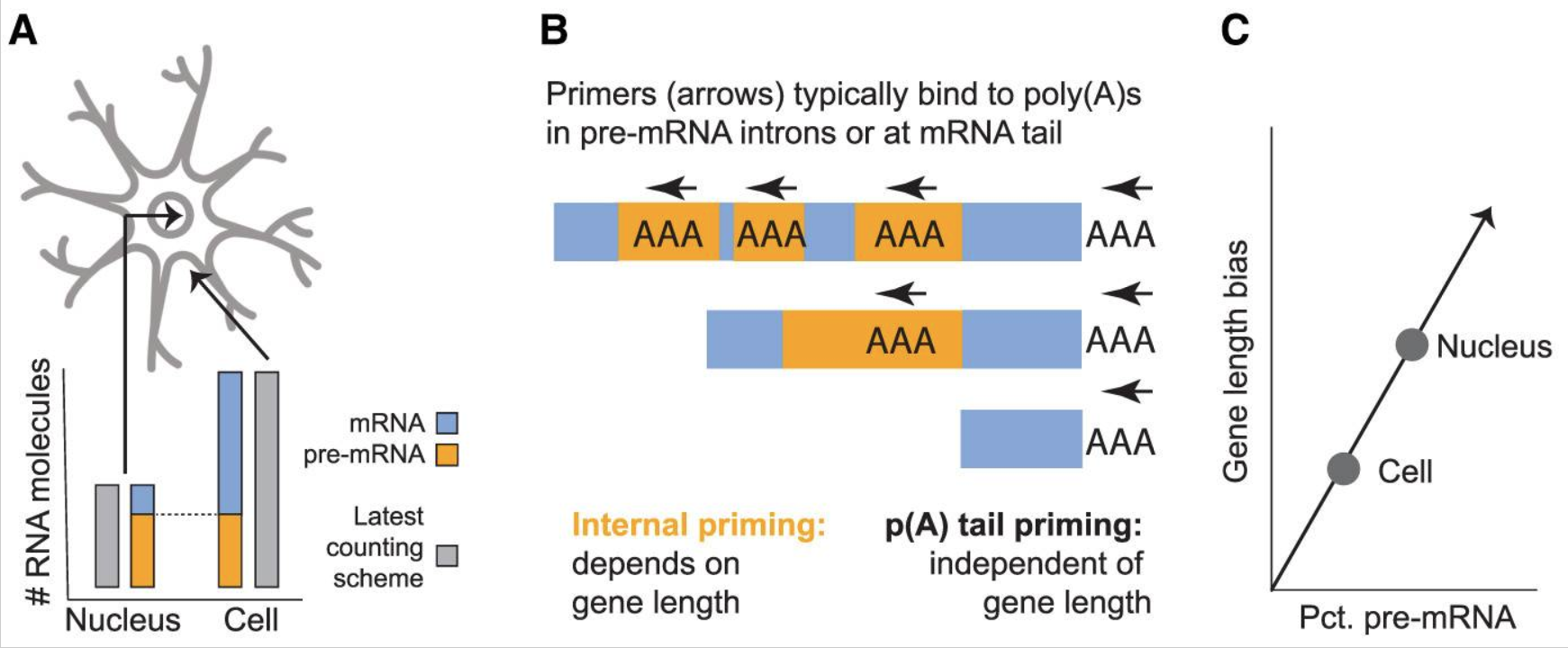
“Conceptual depictions of key technical aspects of sc/snucRNA-seq. (A) Nuclei contain less total RNA but are enriched for pre-mRNA compared with cells. All pre-mRNAs in the nucleus are also in the cell, but most mRNAs are outside the nucleus. (B) Pre-mRNA tends to generate intronic reads via internal priming, which is biased in a gene length–associated matter. mRNA generates exonic reads from priming at the poly(A) tail, irrespective of length. Gray arrows indicate the position and direction of reverse transcription initiation by poly(dT) primers. (C) Gene length bias, or the degree to which long genes are overestimated by the assay, is a function of pre-mRNA content. Nuclei contain relatively more pre-mRNA than equivalent cells.” Differences in molecular sampling and data processing explain variation among single-cell and single-nucleus RNA-seq experiments
If the snSeq experiment involves polyA capture, it’s important to consider gene-length associated bias due to oligo dT binding to adenosine homopolymer stretches commonly found in introns of pre-mRNAs. Each priming event will produce a new unique molecular identifier (UMI), such that the same pre-mRNA can be counted multiple times, a phenomenon that increases proportionally with gene length. Since nuclei contain relatively much more pre-mRNA than cells, this bias is more common in snRNAseq than scRNAseq. Differences in molecular sampling and data processing explain variation among single-cell and single-nucleus RNA-seq experiments Reports also indicate that this effect is highly tissue-specific so it is important to understand the risk to your experiment Single-nucleus transcriptomic survey of cell diversity and functional maturation in postnatal mammalian hearts. Both 10x 3' Gene Expression and Parse use poly(dT) priming during reverse transcription (Parse also adds random hexamers), so keep this in mind when analyzing data and comparing results to published studies. It’s also worth noting that in scRNAseq experiments, mitochondrial DNA (MtDNA) transcripts are used to indicate dying/dead cells in the population. Since MtDNA isn’t found in nuclei, this reporter isn’t available with snRNAseq.
Although thus far this article has focused largely on the differences in information captured from scRNA seq and snRNAseq, both techniques provide excellent representations of the RNA across all cells of the sample population. A recent study demonstrated that both scRNAseq and snRNA seq effectively capture the major cell types in the sample population and provided data permitting thorough characterization of the immune cell subtypes in the samples. Evaluation of single-cell RNA profiling technologies using FFPE, fresh, and frozen ccRCC tumor specimens. 10x Genomics also provides a nice summary comparison of scRNAseq and snRNAseq data found here. We emphasized the differences to assist in accurate data interpretation and assay modality selection but note that both scRNAseq and snRNAseq are valuable single-cell techniques.
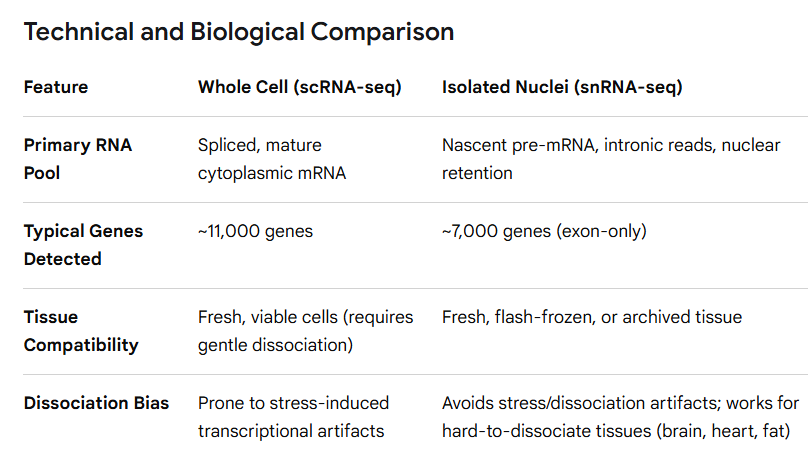
Table source from Google. Numbers come from Single-nucleus and single-cell transcriptomes compared in matched cortical cell types
Sample type compatibility
This section highlights methods for different sample types and different providers. The table below provides some general guidance on which approach aligns best with which sample type but keep in mind that different tissues, whether it is healthy, tumor, fibrotic, or other diseased state will impact assay selection.
| Sample type | scRNA-seq | snRNA-seq | Notes |
| Fresh tissue, easily dissociated (PBMCs, blood, many tumors) | Preferred | Possible | Best recovery of immune cells |
| Fresh tissue, hard to dissociate (brain, muscle, adipose, fibrous) | Often problematic | Preferred | Large or fragile cells (adipocytes, myofibers, neurons) |
| Fresh-frozen / archived frozen tissue | Not recommended | Standard route | Live cells don't survive freezing in most tissues |
| FFPE | No | Yes, via Flex | Flex uses probe-based chemistry |
| Cell lines, organoids | Yes | Yes | Depends on question and logistics |
| Fixed cells or nuclei (PFA, methanol/DSP) | Yes | Yes | Enables batching and shipping; Flex or Parse fixation |
If you are using 10x Genomics methods, this table of compatibility and protocols is a great resource. If you are using Parse combinatorial barcoding, this experiment planner and resource page can help you find the right kit and approach for your sample type.
Psomagen’s sample QC requirements
For single cell sequencing, Psomagen follows strict quality control guidelines to ensure we deliver maximum data quality for all projects. We require a RIN score >8 for fresh or frozen samples and a DV200 score >50% for fixed or FFPE samples. For cells, it is essential to have viability of >80%. Cells that have undergone cryopreservation typically suffer a high loss of viability. Psomagen strongly recommends enriching the viable population using the Levitas EoS for any cryopreserved samples. Samples that fail to meet the quality criteria will not be processed by Psomagen.
Psomagen’s Capabilities
Psomagen offers full workflows for 10x Genomics, Parse Biosciences, and Cellanome (November 2026) and sequencing for a multitude of other technologies. Check out Psomagen’s single-cell sequencing services here.